IoT speaks English... -ish.

Language of Things (LoT) is a scripting language that lives inside your MQTT broker. Define automation, transform data, connect systems. No containers to babysit. No message queues to configure. Just logic that runs the moment data arrives.

Somewhere along the way, you became a DevOps engineer.

Every IoT project starts the same way: get data from devices, process it, send it somewhere useful. Then, reality hits.

You spin up an MQTT broker.

Then a Node-RED instance to transform data.

Then a database connector because Node-RED doesn't scale.

Then Kafka because you need reliability.

Then Kubernetes because you need to manage all of it.

Suddenly, you have 6 services to maintain just to do what should be one job.

We built LoT because we were tired of watching engineers spend 80% of their time on plumbing and 20% on actual automation logic.

Four concepts and you own the stack.

LoT gives you four declarative building blocks.
Master them once to build anything.

Technician wearing a hard hat inspecting solar panels on a rooftop at sunset with the text 'BY INDUSTRY'.
Event-driven logic that reacts to time or MQTT messages.

Check thresholds, transform data, trigger alerts with simple IF/THEN logic.
Learn Actions →
Text on gradient background saying 'Raw data in. Clean JSON out.' with a faint diamond outline.
Define data schemas that automatically structure MQTT messages.

Create virtual sensors, calculate derived values, enforce consistency across your namespace.
Learn Models →
White text reading 'Who can do what, and where.' on a blue-green gradient background with faint curly braces.
Fine-grained access control at the broker level.

Define exactly who can publish or subscribe to which topics. Security without external identity providers.
Learn Rules →
Bridge to other brokers, stream to databases, send alerts, connect industrial PLCs.

Routes handle the connections so you can focus on the logic.
Scaalableconnections
Learn Routes →
Start Building
Black asterisk symbol with rounded edges and a thin blue outline on a transparent background.

Think of LoT as SQL for MQTT.

You know how SQL made databases actually usable? LoT does that for Real-Time MQTT Data.
Write what you want, the broker figures out the rest. Logic runs on publish, not on some polling loop.

//Monitor temperature sensors and automatically send alerts when readings exceed 80°C

DEFINE ACTION TemperatureMonitor
ON TOPIC "sensors/+/temperature" DO
   SET "sensor_id" WITH TOPIC POSITION 2
   SET "temp" WITH (GET JSON "value" IN PAYLOAD AS DOUBLE)    IF {temp} > 80 THEN
       PUBLISH TOPIC "alerts/high-temp/" + {sensor_id}
           WITH "Warning: " + {temp} + "°C"

//Only allow users with the "operator" role to send commands to machines.

DEFINE RULE AllowOperatorControl WITH PRIORITY 1
FOR PUBLISH TO TOPIC "machines/+/command"
   IF USER HAS ROLE "operator" THEN
       ALLOW
   ELSE
       DENY

//Structure raw device data into clean JSON with automatic timestamps whenever temperature updates.

DEFINE MODEL DeviceStatus WITH TOPIC "devices/+/status"
   ADD STRING "device_id" WITH TOPIC POSITION 2
   ADD DOUBLE "temperature" WITH TOPIC "devices/+/temp" AS TRIGGER
   ADD STRING "timestamp" WITH TIMESTAMP "UTC"

//Stream all sensor data directly to a PostgreSQL database for historical analysis.

DEFINE ROUTE SensorDB WITH TYPE POSTGRESQL
   ADD CONNECTION_CONFIG
       WITH HOST "db.local"
       WITH DATABASE "iot_data"
   ADD MAPPING sensors
       WITH SOURCE_TOPIC "sensors/#"
       WITH TABLE "sensor_readings"

Explore the Docs

What Makes LoT Different?

Unified Platform

No Kafka. No Redis. No Node.js.

No container orchestration.

One binary, one process, full stack

Sub-Millisecond Response Times

Logic runs on publish, not on poll.

Messages processed in nanoseconds.

Enable Real-time industrial control.

Reads Like English. Runs Like a PLC.

Show your code to a plant manager.

They'll get it. Show it to an auditor.

They'll approve it.

Unified Platform

No Kafka. No Redis. No Node.js.

No container orchestration.

One binary, one process, full stack

Sub-Millisecond Response Times

Logic runs on publish, not on poll.

Messages processed in nanoseconds.

Enable Real-time industrial control.

Reads Like English. Runs Like a PLC.

Show your code to a plant manager.

They'll get it. Show it to an auditor.

They'll approve it.

Visual Studio Code logo

From Zero to Running
in 5 Minutes.

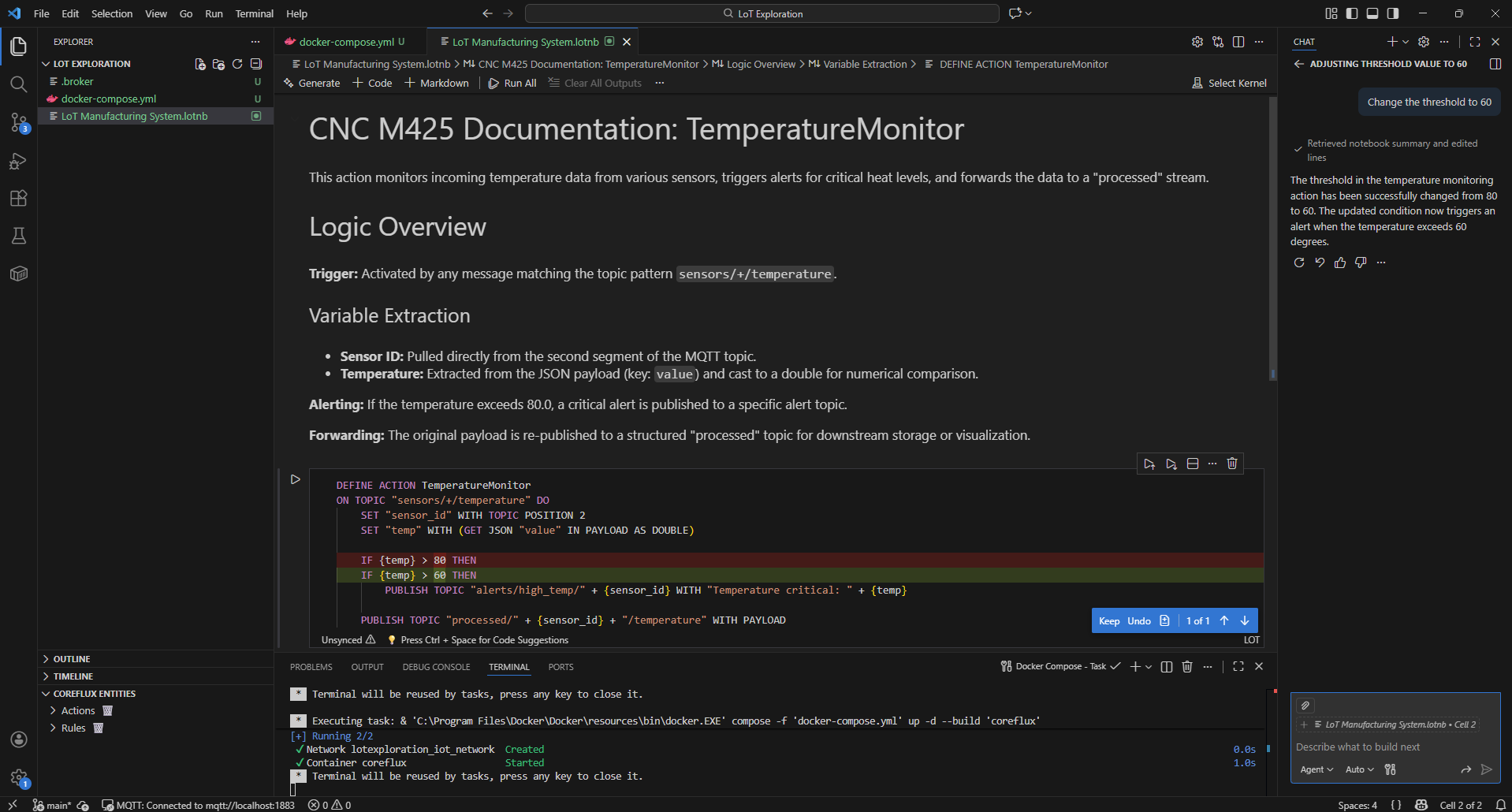
Deploy Coreflux.
Open VS Code.
Write your first Action.
Click Run.
That's it.
Visual Studio Code interface showing CNC M425 Documentation for TemperatureMonitor with code defining a temperature alert action for MQTT topics and a terminal running Docker Compose tasks.
# BUILDING THE FUTURE

Co-financed by the Portugal's "Recovery and Resilience Plan (RRP)" Program, a part of Europe's "NextGenerationEU" which contributes to ensuring long-term sustainable growth and responding to the challenges of the twin climate and digital transitions. This support has determinately contributed to the development of green-tech solutions with an impact on sustainability, and the internationalization of the products via eCommerce.

COMPLETE & ONGOING PROJECTS (2023 - present):

• Vouchers para Startups - Novos produtos verdes e digitais (Ficha de Projeto)

• Transição digital das empresas medida "Internacionalização via E-commerce"
(Ficha de Projeto)